

Tag: Recipe

  • Guest Post – Queijadas de Leite from Easy Portuguese Recipes

    Azulejo 14I was contacted recently by Pedro Bicudo from the Easy Portuguese Recipes website who offered to write a guest post for In Love With Lisbon. As I know you all love your recipes, I thought this was a great idea! Do check out the website. Not only do Pedro and his cousin Tiago Moniz provide recipes but there are also some excellent videos for those of us who need some extra help with cooking skills!

    Over to Pedro Bicudo…

    Portuguese cuisine is all about simplicity and enjoyment. Enjoying the act of cooking has always been just as important as the eating of the food itself. Whilst that may not be the protocol of most fine European cuisines, we have always focused on what matters most; flavor and ease to make. We like to use few but flavorful ingredients whenever we cook to get the most taste out of every component.

    Desserts are the most widely known aspect of Portuguese cuisine. Almost all Portuguese have a sweet tooth and so we have found many ways to satisfy those needs whether it be cakes, puddings, fruit medleys, or especially – cupcakes. Portuguese cupcakes, known as “Queijadas” or “Pasteis” are the most popular of all Portuguese desserts and so we would like to show you how to make one of the most delicious and traditional cupcakes of them all, Queijadas de Leite.

    Queijadas de Leite 
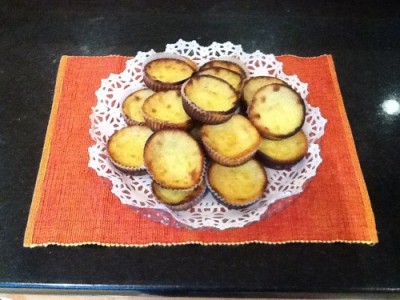
    Queijadas de LeiteThe sweet fragrance of Queijadas de Leite emanates those that are freshly made daily from many Portuguese bakeries. There is no surprise as to why these are some of the most popular Portuguese desserts. These delicious Portuguese cupcakes have the perfect amount of sweetness and an awesome lemony kick to them. They are really simple and easy to make. This is a traditional family recipe which has been enjoyed for many generations in our family and by many Portuguese people for centuries.

    Ingredients:

    • 2 cups of sugar
    • 3 eggs
    • Half a stick of melted butter
    • 3 cups of milk, almost boiling
    • 1 cup of flour
    • 1 Lemon or Orange rind – finely grated
    • 2 cupcake sheet pans
    • 12 Cupcake baking papers

    Directions:
    1) Beat together the sugar with the eggs, rinds, and melted butter in an machine beater for a couple of minutes

    2) Add the milk and flour sparingly until it is will mixed.

    3) Butter the cupcake baking papers in the sheet pan and add a little flour before you place the mix into it.

    4) Place in the oven at 350 for 45 minutes to an hour.

    5) Remove from the oven, place onto a serving platter, and enjoy!

    Other great Portuguese Recipes:
    http://www.easyportugueserecipes.com/portuguese-papas-porridge-grits/
    http://www.easyportugueserecipes.com/portuguese-clams-in-garlic-sauce-ameijoas-com-alho/
    http://www.easyportugueserecipes.com/homemade-fresh-cheese-2/

    We at EasyPortugueseRecipes.com are two second generation Portuguese-American cousins who cherish our heritage by enjoying the delicious food made for centuries by our ancestors. We want to share all the recipes passed down to us through numerous family recipe books which contain unique and sometimes secret recipes, enjoyed for many generations. We try to focus on the “comfort food” side of Portuguese cooking, rather than difficult to make fine European cuisine.

  • Lily Makes Bolo Rainha

    azulejo11.jpg

    So the plan was to make Bolo Rei – a traditional Portuguese cake/bread. Bolo Rei is a sweet rich fruit bread laced with port that was originally made to be eaten at Epiphany (January 6th) but these days is eaten throughout the festive season. Bolo means ‘cake’. Rei means King.

    But Bolo Rei is meant to have crystallised fruit on the top – highly decorative and colourful, reflecting the jewels in a Kings crown. I bought all my ingredients and then hit a hurdle when it came to the crystallised fruit. All three of my local (and large) supermarkets didn’t stock it and I was at a loss of where to go and short on time. Somehow I recalled that Bolo Rei without the crystallised fruit is called Bolo Rainha. Queen Cake then is my offering to you this Yuletide 🙂

    The recipe I followed I found on Delia’s website here

    Ingredients

    100 g (3 1/2 oz) glacé citrus peel chopped
    50 g (1 1/2 oz) raisins
    50 g (1 1/2 oz) pine nuts – I used almonds as the shop was out of pine nuts (!)
    100 ml (3 1/2 fl oz) port
    2 1/2 tsp dried yeast
    100 ml (3 1/2 fl oz) warm water
    500 g (1 lb) strong white bread flour
    1 1/2 tsp salt
    100 g (3 1/2 oz) unsalted butter softened
    100 g (3 1/2 oz) caster sugar
    zest of 1 lemon and 1 orange
    3 eggs beaten

    Ingredients

    For the topping

    egg glaze made with 1 egg yoke beaten with 1 tbsp water
    glacé cherries
    Sliced almonds (my addition as I think they look pretty)
    Caster Sugar
    apricot jam to glaze
    Icing sugar to decorate

    Method

    Soak 
    1. Soak the glacé peel, raisins, and pine nuts/almonds in the port overnight. Sprinkle the yeast into the water in a bowl. Leave for 5 minutes; stir to dissolve. Mix the flour and salt together in a large bowl. Make a well in the centre and pour in the yeasted water.

    2. Use a wooden spoon to draw enough of the flour into the yeasted water to form a soft paste. Cover the bowl with a tea towel. Leave to sponge until frothy and slightly risen, about 20 minutes.

    Ok so I fell at the first hurdle by not quite understanding the instructions (I don’t bake that often!). After mixing all the yeasted water with ALL the flour I realised I hadn’t got anything like a paste – oops. I started again, this time mixing the yeasted water with about half of the flour to make the paste like consistency required.

    ButterSugar 

    3. Beat the butter with the sugar and lemon and orange zest together in a separate bowl until light and fluffy. Add the eggs, one at a time, and beat well after each addition. Add the mixture to the flour well, then mix in the flour from the sides to form a soft dough.

    I’d like to add that stage 3 was where I discovered my grater was as blunt as a bottle nosed dolphin and had to resort to finely chopping my zest – which took forever…

    4. Turn the dough out on to a lightly floured work surface. Knead until soft, smooth, silky, and elastic, about 10 minutes. Knead in the peel, raisins, and pine nuts until evenly distributed.

    I discovered here that maybe I should had drained off the port from the soaked raisons and pine nuts…

    5. Put the dough in a clean bowl and cover with a tea towel. Leave to rise until doubled in size, about 2 hours. Knock back, then leave to rest for 10 minutes.

    Ok so after an hour I just thought ‘this is never going to rise’ and moved on to the next stage. Next time I will find a warm place instead of leaving it in the freezing kitchen AND leave it for the required 2 hours…

    6. Shape the dough into a ring (I separated the dough and made two rings), then place it on a buttered baking sheet. Put a jar or bottle in middle to hold shape.

    7. Cover the dough with a tea towel, and leave to prove until doubled in thickness, about 1 hour.

    Ok this time I figured the kitchen was too cold so left it in a warmer room and saw a little improvement…

    ReadytoCook

    8. To make the topping. Brush the dough with the egg glaze then decorate with the glacé fruit and the caster sugar. Bake in a preheated oven 210c for 45 minutes until golden. Warm the apricot jam in a saucepan over low heat until liquid, then brush the top and sides of the bread with it to glaze. Brush? I’m supposed to have a cook’s brush? Ok, spread thinly with clean fingers…Leave to cool on a wire rack.

    After around 25 minutes in the oven I peeked and discovered both my cakes had risen like crazy, closing the holes in the centre. Note to self, next time make the holes much bigger or cook around a jam jar perhaps…

    After the required 45 minutes my bolos where starting to look very brown yet the insides seemed uncooked. Frustrated at this point with my significant lack of cooking skills I took them out of the oven and fought the impulse to throw them both straight in the bin. They did however smell good so I cut both to see how they had cooked. Of course both were boiling hot at this point so I didn’t consider how the texture would change or that they would continue to cook until the heat dissipated. The fabulous Christmassy aroma however soothed my bruised cooks pride and I decided to let them cool down to see what happened.

    A while later I realised that I had two very tasty if rather hacked-to-pieces cakes. I gave some to a certain Portuguese person who informed me that it tasted good. Happiness! I think it tastes rather fine too. He also gently informed me that he doesn’t know anyone who cooks Bolo Rei or Bolo Rainha back home as everyone just buys them from on of the myriad of shops that stocks them. After my kitchen trials I’m thinking no surprise there! That said, I have some ingredients left and a willing heart. I might just make another…

    Feliz Natal!

    Cooked