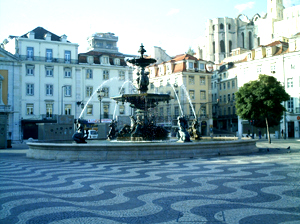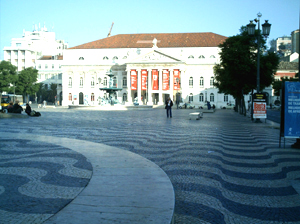
 Before the great earthquake of 1755, Commercial Square was the seat of power for the Portuguese royalty for around 200 years. In those times it was named Terreiro do Paço (The Palace’s Square) and was the home of the Portuguese Royal family of King Manuel 1st. After the earthquake destroyed the palace, the Marquis de Pombal saw to the uniform re-creation of Lisbon and Terreiro do Paço became Praça do Comércio – Commerical Square. Many of the roads in Baixa (downtown Lisbon) were given names such as Rua dos Sapateiros (Cobbler Street) to create an orderly layout of both streets and people. Certain professions were given their own roads. Commercial Square did exactly what it said on the tin. It became the hub of commerce in Lisbon, comprising governmental buildings dealing with import and export and more.
Commercial Square has been called the ‘reception room of Lisbon’. Built on the edge of the Tagus river, the square became a warm sunlit welcome to visitors. With the port lying at one end and grand buildings surrounding it, Praça Comércio provided a regal and proud gateway into Lisbon.
As you cross from Rua Augusta into Commercial Square you walk under the Arco do Triunfo or Triumph Arch. This colossal piece of architecture was only completed in 1875 and designed by Veríssimo da Costa. Take a moment to look up and you will see representations of Portugal’s glorious history carved upon it. The Marquis has a place here, as does the famous pioneer of the seas; Vasco de Gama. On either side of the Arch are figures representing the two main rivers of Portugal, namely the Douro and the Tagus and crowning the Archway is a statue to Glory, Ingenuity and Valour, three attributes of the spirit of Lisbon. The Archway above all captures the strength of Lisbon in it how it rose from the rubble of the earthquake to be rebuilt.
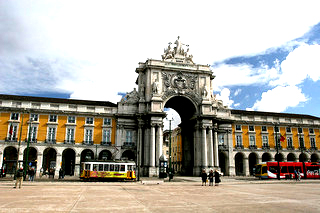 Praça do Comércio by zoonabar on Flickr
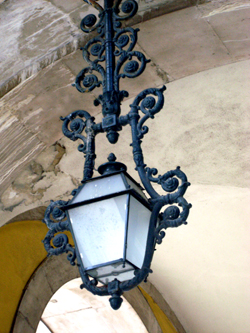
Within the Arch there is also a clock. Once upon a time the King of Portugal commisioned a beautiful clock tower that was part of the palace. When it was destroyed in the earthquake, it was to be another century before the hands of time once again were visible on the square. A hundred years ago the clock was replaced but fell into disuse through neglect. Last year work began on it once more to restore time to Lisbon. When I visited, a huge banner covered the restoration work.
At the centre of the square you cannot fail to miss the gigantic bronze statue of Dom José upon his horse. The horse tramples snakes beneath its feet. Whilst on my Lisbon Walk, the tour guide mentioned that the snakes were meant to represent the Jews who were expelled from Lisbon in the 1400’s. On either side of the base of the statue are two further figures: Triumph leading a horse and Fame leading an elephant – presumably a visual representation of Portugal’s success in the spice trade with India.
Praça do Comércio is one of my favourite places to just sit and watch the world go by. The light here is exquisite and I love the feeling of being ‘at the centre’. Tourist buses and trams meet and leave from here, walkers congregate here and people populate the cafés that are dotted around the square. The most famous of these is Café Martihno da Arcada on the top left hand corner (as you come through the Arch).
History is all around you in this place. Here was once where Royalty reigned, where destruction followed where new dreams began. Here is where the last King of Portugal was assasinated. Here is where every year a giant Christmas tree stands and where many gather to welcome in the New Year.
Whilst you are visiting Lisbon, you are very likely to pass through Commercial Square at some point or other, if only because so many trams and buses stop here. I would recommend taking a half hour out of your day just to wander then sit and wonder at one the the most beautiful squares in Europe.
For further details on the renovation of the clock in the arch see here