
Tag: Castelo de São Jorge

  • Ao Viandante – A Portuguese Poem

    Azulejo 20This is a poem that sits under a tree in the hushed gardens of Castelo de São Jorge. For some reason it really caught my eye and I spent quite some time there just looking at the words, trying to understand, trying to get the gist of meaning. A kind Brazilian man saw me looking and came over and read the poem to me, first in Portuguese and then in English. I was entranced.

    Perhaps it is because I have always felt a connection to trees, perhaps that it was a special moment in a quiet place. Perhaps it is because the poem says something so important so simply. To protect the enviroment is to protect ourselves.
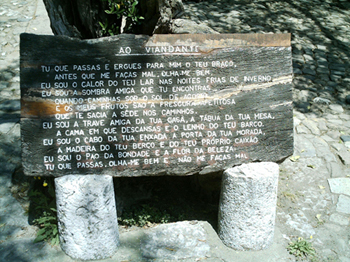
    Ao Viandante
    © ILWL

     Ao Viandante

    Tu que passas e ergues para mim o teu braço,
    Antes que me faças mal. Olha me bem.
    Eu sou o calor do teu lar nas noites frias de inverno
    Eu sou a sombra amiga que tu encontras
    Quando caminhas sob o sol de agosto
    E os meus frutos são a frescura apetitosa
    Que te sacia a sede nos caminhos.
    Eu sou a trave amiga da tua casa, a tábua da tua mesa,
    A cama em que descansas e o lenho do teu barco
    Eu sou o cabo da tua enxada a porta da tua morada,
    A madeira do teu berço e do teu próprio caixão
    Eu sou o pão da bondade e a flor da beleza
    Tu que passas, olha-me bem e não faças mal

    Veiga Simões, Arganil, Maio de 1914
    Veiga Simões was a brilliant Portuguese politician, diplomat, writer and journalist.

    To the person who passes through this place

    You that pass and raise your arm to me
    before you hurt me, look at me well.
    I am the heat of your home in the cold winter nights.
    I am the friendly shade that you find
    when walking under the August sun
    And my fruits are appetizing freshness
    That satisfy your thirst on the way.
    I am the friendly beam of your house, the board of your table
    the bed in which you rest and the wood of your boat.
    I am handle of your hoe, the door of your dwelling
    the wood of your  cradle and of your own coffin.
    I am the bread of goodness and the flower of beauty.
    You that pass, look at me well and do no harm.

  • Ulysses- The Founder of Lisbon

    Azulejo 10Whilst modern methods often unravel true history, the magnetic attraction of mythology is rarely undone. We find this in the story of the birth of Lisbon. Despite the almost indisputable fact that it was the Phoenetians who were the first people of Lisbon, the legend of Ulysses refuses to die.

    Ulysses was the Latin name for Odysseus. Odysseus was the great hero of Homer’s Odyssey. Born of the King of Ithaca, Odysseus was once a suitor to the most beautiful woman in the world (Helen of Troy). Though he was not chosen by her to be her husband, he made a show of loyalty to her and made all her suitors promise to protect her. However when she was captured by Troy, Odysseus did not want to go to battle and pretended instead that he was mad! Soon however, he made good on his original promise and became the man behind the idea of the Trojan Horse. He was a great warrior of the mind, skilled in strategy – cool, calm and collected. His loyalties were governed by intellect and therefore they could change according to the politics of the situation. For this reason Odysseus was also known for his lies but the lies stemmed from a belief that he was serving a greater good and that was always to protect his homeland.

    He married the lovely Penelope who stayed faithful to him even during the 10 long years it took for him to return from Troy. It was during this tempestuous journey that Odysseus founded Lisbon. He had battled sea monsters, giants and all manner of strange things but one day a bolt of lightning appeared and exploded into flame in an unknown land. It is said that when Odysseus reached the source, he was instructed to build a city on the point of impact and this was the beginnings of Lisbon. He followed what was likely to be the instruction of Zeus (for he was the great God of Thunder and Lightning) and named his city Ulisaypo or Olissopo.

    Olissopo became Alisubbo (meaning ‘friendly bay’) to the Phoenicians. Later this changed with the coming of the Moors to Al Aschbuna. This then merged to become Lissabona which is the forerunner to what we know today as Lisboa.

    Today Odysseus is still remembered within Lisbon as he has a tower named after his Latin counterpart in the Castelo de São Jorge. It is perhaps very fitting that the Tower of Ulysses  houses the Cámara Escura (Camera Obscura).

    Invented by Leonardo Da Vinci, this optical system projects a 360 degree view of the city. It is as though Ulysses is everywhere the eye can see. He was brave, loyal, cunning, wise and tenacious – qualities that are found in abundance when we look to the history of Lisbon. Remember, as you look out from the battlements of the Castelo, it rose from the ruins of the great earthquake to be the beautiful place we know today.