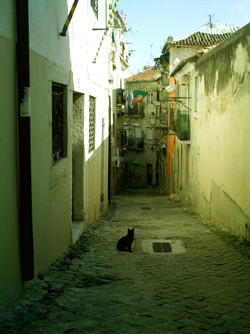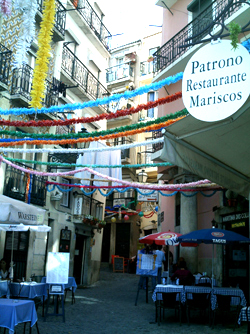
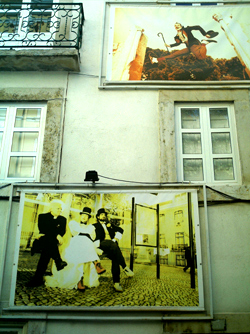
 Chapitô is situated in Alfama on a quiet, unassuming street. The first time I visited Lisbon, apart from spotting the huge posters on the building, I had no idea that there was a restaurant there. To get there, first take Tram 28 to the Castle stop. There’s a sign pointing to the castle to the left when you get off. Follow the crowds up the little winding road but when you reach the gateway through to the castle, take a left then take the first right. This is Costo do Castelo. As you walk down the road, on your left you’ll see a large white building with giant pictures of circus acts hanging down from it. It’s a fabulous building. Built in the 17th century, it used to be a prison but now is used as a state funded school for circus performers.
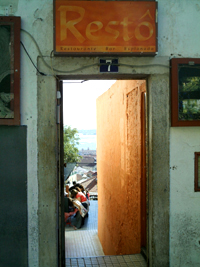
As you pass the building, look out for a small gateway in the white wall. This is the entrance to Chapitô – very easy to miss but the picture here will at least mean you know what you are looking for.
As you walk down the steps into the gardens you’ll be treated to a stunning view over Alfama and beyond to the river. When I visited, there was a lovely stall on the steps selling home-crafted jewellery. I bought myself a pendant as everything was very reasonably priced and well made.
I chose a spot set just above the main table area as I wasn’t planning on eating and wanted to take in the glorious view. The whole place was buzzing with people but there were plenty of places to sit both sheltered and in the sun. Tapas seemed to be the thing that most people were ordering and there was a good deal of laughter and cheer. Chapitô has a funky feel to it and whilst the majority of people were probably around student age, there were also a fair view older visitors. The music varied between chill-out to hip hop to beautiful Indian music.
I waited for 10 minutes or so to be served. I could see the waitresses were busy but I wasn’t quite sure whether I was supposed to have gone down to the little cash desk near the door to the main building to order. Meanwhile I realised I had chosen the ‘photo spot’ to sit and several people with very large and expensive looking camera’s stood over me to find the perfect shot. I probably ended up on a few of them! Eventually after catching the waitress’ eye several times, I decided that maybe I was supposed to go and order my coffee from the desk. Once I got there the waitress barked ‘yes’ at me, immediately speaking in English. I smiled, ordered my coffee quickly and scuttled back to my seat.
A few minutes later, the harassed waitress brought me my coffee. I gave her my best “I know what it’s like to serve in a cafe on a really busy day” look of sympathy. She then beamed me a “I’m sorry” smile and went back to her business. Having worked in a cafe, I really do know what that feeling is like.
I sat and enjoyed my coffee, taking in the beautiful view and quietly watching other customers eating and drinking. It was immediately obvious how popular this place is. I loved the slightly ramshackle look of everything yet there were flowers everywhere and beautiful sculpture that brought the place to life. There was a buzz of creativity.
Whilst I visited in the daytime, I hear that Chapitô is great for an evening dinner. The food is tasty, the atmosphere is sparkling. Live music, circus performers practising their art and of course performances by the Chapitô company. Currently they are performing Dracula.
I recommend a visit to Chapitô, even if only for a coffee. The views are wonderful and the whole vibe is funky, quirky, bohemian and relaxed.
Official Site (in Portuguese)
Costa do Castelo, nº 1 / 7
1149-079 Lisboa
Portugal
If you are interested in seeing more about the work of Chapitô circus troup take a look at their youtube profile