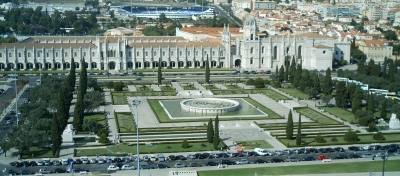
 Jeronimos Monastery (Mosteiro dos Jerónimos) is one of the most beautiful buildings in Portugal and a prime example of Manueline architecture. Sitting opposite the Discoveries Monument, it is one of Lisbon’s ‘must see’ attractions regardless of spiritual persuasion. In 1983, the monastery was given the classification of a world heritage site by UNESCO.
Commissioned by King Manuel 1st, the building began construction on the 6th January 1501. Originally the site was home to the Hieronymite religious order and to monks who aided visiting pilgrims. The chapel that existed there was dedicated to Santa Maria de Belém. The small beach of praia do restelo provided a safe harbour for tall ships sailing along the river. It was in the hermitage of the old building that Vasco de Gama and his shipmates stayed the night before setting out on their first voyage. It is here too that the remains of Vasco de Gama are interred along with other famous figures from Portuguese history.
The Hieronymite order were allowed to stay in the monastery. Their role was to pray for the kings soul and for the souls of the brave sailors whose voyages were increasing the riches of Portugal. Much of the construction was paid for with a tax on commercial endeavours from overseas trade.
 This vast building has two entrances – the South Gate and the main entrance which is the Axial Portal. Before you go in, take a moment to study the exquisite carvings that decorate both. On the South Gate you’ll find the figure of Santa Maria de Belém, Saint Jerome (after whom the monastery is named) and the Archangel Michael, the protective angel of Portugal. Images of Saint Jerome appear throughout the building and you can recognise him by the fact he is normally accompanied by two lions.
The smaller but no less impressive main entrance contains religious and Portuguese iconography – cherubs, angels and saints, an armillary sphere, the coat of arms of Portugal, scenes from the nativity, King Manuel himself and his queen and much more.
Going through the Axial Portal, you enter the Church. This is still used as a place of worship so be aware that there may be a service taking place. Mass is early morning and late afternoon.
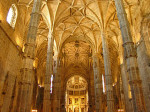
The Church is breathtakingly beautiful with is vast high arched ceiling held up by octagonal pillars. A spider’s web of carving weaves across the vaulted ceiling. The pillars themselves are intricately carved with a variety of motifs. Even through the hum of tourist whispers and footfall, a hush of peace hangs in the air. Light streams through the stained glass windows. Note that these are not the original windows as these were destroyed in the great Lisbon earthquake in 1755.
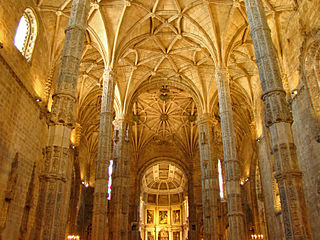 In the Church you will find the tombs of Vasco de Gama and Luís de Camões who wrote the famous Portuguese narrative poem ‘The Lusiads’ which chronicles and celebrates the great maritime adventures of the Discoveries era. King Manuel 1st himself is also buried here along with other Portuguese royalty in the marble chancery. The royal tombs are help up by glistening marble elephants. In the chapel behind the altar are master paintings in classical style.
Whilst a visit to the Church is free, if you want to enter the cloister there is a fee to pay however it is well worth it to see the inner sanctuary. The cloister here is considered to be one of the most beautiful in the world. The golden limestone seems to shimmer as it opens in archways to the light pouring into the perfect rectangular garden. Again, almost every surface is ornately carved with everything from planets and animals, the Virtues, nautical and religious themes. Look hard and you will even find sea monsters! It’s also within the cloister that you’ll discover the resting place of Fernando Pessoa. The cloister is a perfect thinking spot and I found myself reflecting on the echoes of the soft tread of a monks feet centuries before.
From the cloister you can enter the refectory where the monks once gathered for dinner and readings of the Bible. Check out the intricate mosaic freeze that runs around the entire room depicting biblical stories.
Back through the cloister and up to the Choir balcony you get a fabulous upper view of the church. With its huge rose window and large statue of Christ this is a quiet place of contemplation where the monks would meditate. Take a look at the polished wooden seats as each is carved with fantastical designs and different from the other. Above the stalls are more classical paintings showing various saints.
Jeronimos Monastery is a majestic tribute to the opulent history enjoyed by Portugal during the discoveries era. In modern times, the monastery continues to make history by hosting important ceremonies of state such as the signing of the Treaty which marked Portugal’s entry into the European Economic Community (the body which preceded the EU).
On my first visit, I went on a Wednesday early in the morning and was lucky that it was reasonably quiet. The second time I visited (to get photos that I didn’t manage to get the first time around!), the queue was long, the sun was hot and I ended up foregoing site-seeing in favour of a long, cool drink. My advice is to head out early to avoid the hoards of visitors that this heritage site attracts.
Location Praça do Império, Belem View Larger Map How to get there Tram 15 from either Praça da Figueira or Praça do Comércio Opening hours October to May - 10.00 am to 5.30 pm May to September - 10.00 am to 6.30 pm CLOSED – Mondays, 1st January, Easter Sunday, 1st May and 25th December Price The church is free Access to the Cloisters is free with a Lisboa card or €7 (free up to 2pm on Sundays) Combo tickets are available for Belém Tower and other attractions. Free access with the Lisboa card Children up to 14 go free Senior citizen 50% reduced rate Official Website http://www.mosteirojeronimos.pt/ Resources A 3D tour from Arounder.com Jeronimos Monastery on Facebook Short official video guide Images Interior of Mosteiro dos Jerónimos by Lacobrigo on Wikipedia [creative commons] Exterior view from the top of the Discoveries Monument by Lily


