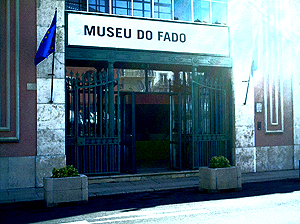
The Fado Museum (Museu do Fado) is a must do trip for those who love Fado music as well as those with an interest in Portuguese culture and history.
Situated on Largo do Chafariz de Dentro, the museum is right opposite the entrance to Alfama. The easiest way to find it is to simply walk towards the sea on Praça de Comércio and turn left up the main road (Avenida Infant Dom Henrique). It’s about a 5 – 10 minute walk along the water front and is situated on the right. Alternatively you can take bus number 28.
The museum opened in 1998 and is located within a spacious well-designed building that still smells new. It costs €5 (2012 price) to enter and you are not allowed to take photographs. Both times I have visited, the museum has been quiet although as with most tourist attractions, it is busier at the weekends.
Despite being quite a small museum, they have a packed collection that includes interactive features. The permanent collection is a wonderful journey through the history of Fado – the music, the singers, the musicians and instrument (namely the Portuguese guitar).
There are hundreds of photos of famous singers as well as posters of old advertisements. Every wall is crammed with information on how fado developed as a musical genre. You can listen to the different types of fado as well as different artists. My favourite part of the museum is the model Portuguese guitar workshop. A wax work figure stands over his tools as a film runs behind him showing how a Portuguese guitar is made. As a musician I have always been in awe of master instrument makers. Along the wall is a large display of different makes and models of guitar. My fingers were itching to play!
The last room is a wonderful installation that recreates a fado bar. Last time I visited I was the only person in there so it was easy to feel like I had been transported back in time. The room is dark and atmospheric. Glass cases of original costumes worn by great Fadistas like Lidia Ribeiro, Maria da Fé and Amalia line the back walls. All around the room are photographs of Fado in action and of course there is fado playing as you stand and absorb the atmosphere.
The museum has space also for temporary exhibitions. Past exhibitions are listed on their website if you would like to know more. There is a cafe which wasn’t open when I was there but according to their website it is open at the weekend and Fado is played live.
You’ll find the shop very expensive but it does have an excellent selection of fado music as well as some lovely books on art and culture in Portugal as well as fado. My only disappointment was that they did not have any posters. I love the old Fado advertisments – particularly those by Stuart Carvalhais and would love to have some prints of his work.
The Fado Museum is the perfect place to pass an hour in the late afternoon. From there you can cross the street and be right in the heart of old Alfama ready to spend the evening in the arms of fado.
Museu do Fado (in Portuguese and English)
Opening Times: Tuesday – Sunday 10 – 6pm (last admission 5.30pm).
This post is dedicted to the musicians I met one day in Lisbon…thank you for the music.
It seemed incongruent to say the least. I had spent the last 25 minutes immersed in the Lisbon Experience film shown within the Discoveries Monument in Belém and now as I walked out into the wall of sunshine, music was playing loudly. Two men dressed as Native Americans were busking Abba songs on panpipes behind the monument. Amplified to the hilt, the famous ballad Fernando reverberated from The Discoveries to the Torre and back again.
It brought a smile to my face. The music, costume and choice of instrument seemed so out of place but this was a song I loved as a child.
It was my 3rd day in Lisbon. I had come alone for an adventure. I had never been abroad alone before. I knew what I planned to do but I also knew that I had no idea what would happen. I wanted to have no expectations aside from hoping for sunshine and a clean room. I wanted to let the experience unfold and see where it took me both emotionally and physically. The past couple of years had been a difficult process of letting go of the person I once was without knowing what I was becoming. The road ahead was often unclear, the horizon shifting and changing every time I thought I had got a handle on it.
As a child I would sit in the back seat of the car on long trips and watch the cars travelling in other directions. I would stare hard into other lives going somewhere. I would often wonder if I would ever see their faces again or if they would remember me – a five year old’s face in the back of a car, going somewhere.
It is fair to say I have spent much of my life as a dreamer. In childhood I believed my night-time dreams were as real as waking life, the friends I made there as close as those in school. My day dreams were imaginative and took me to other worlds and other places. I dreamed of being a foreigner in an unknown world. I felt like a foreigner in my own country. As I grew up I helped other people understand their dreams. I knew their language and could see patterns and connections where others didn’t. I understood the story they told and what they meant. My own dreams whispered and sometimes shouted in my ear.
I had read something somewhere that poses the question “If you speak a foreign language are you a different person when you speak that language?” As I stood beside the Discoveries monument with Fernando in my ear I pondered this thought. My initial reaction was of course not, I’m still me whatever language I speak. Yet I also considered how different languages mean that there are different rhymes in poetry and song to be found, different sayings and puns, different histories that have moulded the shape and pronunciation of words. In English the word trivial comes from the Latin ‘tri via’ – a place where three roads meet. Once this would have been seen as a magical place but years of erosion of the old shamanic ways have meant they have literally been trivialised. Language is three dimensional.
Language is also powerful, ‘words’ is an anagram of ‘sword’. Words can heal and words can kill. Our night-time dreams use language and symbolism to present complex layers of meaning in the most economical way. You would perhaps be surprised to know how often dreams play on puns and old sayings whether or not we agree or disagree with them in waking life. I recognised in that moment that whilst my spoken tongue was my native English, I also talked to myself in the language of dreams, in signs and symbols, in music, in pictures.
So I considered then that rather than making me a different person, perhaps learning a new language gives us new ways of expressing what is already there. Maybe I could go further and say that perhaps learning a new language helps us access parts of ourselves we never knew were there. It’s like when we meet a new friend or experience a profound relationship of any kind, those people bring out aspects of ourselves that had previously been hidden.
We all have an internal voice that comments on the world we are experiencing as it happens. My internal chatter has always been loud and sometimes she speaks with many voices. When I speak to others, I am seeking to make a connection, to be understood, for them to see me for what I am. But in order for that to happen, I also need to know who I am; to be able to describe myself to myself. I used to think I knew who I was. I knew which words to use to describe myself. I am this or I am that. Then along came a time when this or that suddenly didn’t make any sense any more.
What language does is complex and simple. It allows us to ask for a drink of water when we are thirsty, explain our tears when we cry. Yet language is not just words – it is music and pictures and a smile from a stranger.
I considered the thought that learning a new language means I have new ways to describe my experience of the world. Different words make different rhymes so in songs I can explore new images and make connections that would not necessarily be made in my native tongue. I wondered if the new doors that were opening in my mind needed to speak in Portuguese to be able to fully show themselves to me.
I shook myself out of my revery. The sun was baking hot and I wanted to get back into the centre of Lisbon as I had other places to visit. As I reached the underpass which would take me across to the Jeronimous Monestary, I heard more music floating up to me. As I stepped down into the tunnel I saw a busker playing soulful jazz which perfectly suited the acoustics. I flicked a coin across to him. He stopped and smiled then continued to play, using his saxophone to flirt with his audience.
On the tram back into town I gave my seat to an elderly lady. Since arriving in Lisbon I had noticed how the elderly seemed more visible. Was it simply the sunshine that made it possible for them to venture from their homes, or the still strong religion that brought them out of memories and into mass? Was it that in Portugal the old are afforded a status that here in England they seem to have lost?
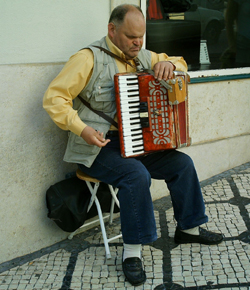
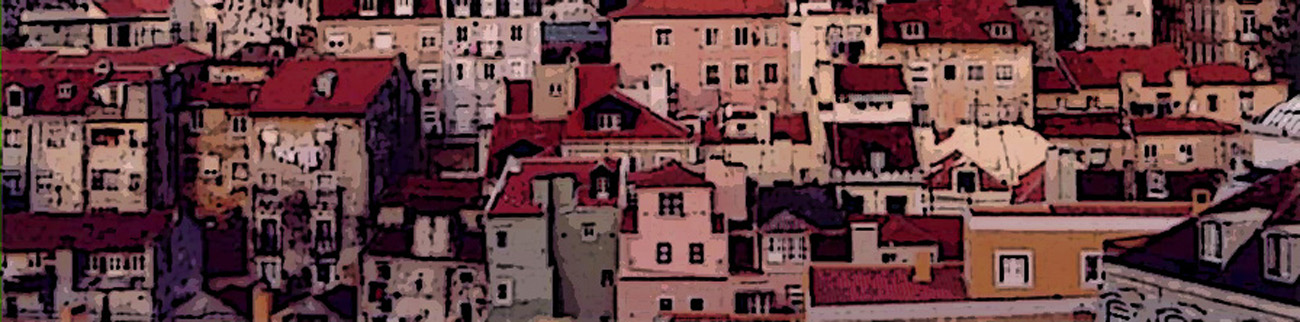
Lisbon feels like a place of paradox. The city has a powerful history and an enduring nature. Palacial buildings and evocative statues populate the skyline yet there is an all pervading air of what once was. Trendy clubs, alternative art and new music merge with smoky bars where old men play cards and traditional fado houses. The streets range from Chiado designer to tiny shops that seem to have been passed down in families like the seed shop on the corner of Figueira Square. Gothic ruins blend with eighteenth century smart houses. Disfigured beggers drone their pitiful cries from the doorways of churches. A blind talented accordian player smiles at the chink of money that is dropped into his waiting box. On Rua Augusta, a sad Chihuahua sits stoicly holding a tiny basket in its mouth as its busking owner plays and hopes that the cute factor will sway the lack of musical talent. Halfway up Rua Garrett there is a begger whose occassional trills on his tin whistle remind me of another who busks in Manchester, UK and even his dog has a typical ‘Manc’ look with a coloured hankerchief tied around his neck. I give in an give him a cigarette as I pass and when he speaks, his voice is an echo of heroin addicts everywhere – the language may be different but the tone is always the same.
I sat on Praça Comércio and noticed that footsteps in Lisbon are unhurried. Was it simply the sun or was it that people allowed themselves to take time there? They let their hearts relax and find space to think even if they are just on a lunch break. People smile, talk loudly, laugh. It mades me conscious of the cynicism in England, the dour light and the defensive posture. Coming from the English countryside I learned to be streetwise the hard and fast way, yet there in Lisbon whilst I was aware I did not feel defensive. I stared up at the archway and an overwhelming sense of pride leapt up in me. It was pride that built the arch as much as fingers and stone.
In Manchester we pull down the old buildings or renovate them to become plush unaffordable apartment blocks that call out to the young and monied. Lisbon seems free to allow some of its buildings to quite simply fade. There is no pretence, no sense of having to do or be anything other than it is. I think one of Lisbon’s strengths is that it accepts itself as it is.
I wandered to Café Brasileira and sat near the life size statue of Fernando Pessoa, smiling as the Abba song continued to play in my mind. I realised I would be a part of many memories as the tourist cameras clicked around me. I thought about how revered poetry seemed to be in this place and how every Portuguese person I had met so far seemed to know so much of their own country’s history. In England, whilst Shakespeare and the Romantic poets are taught in schools, our literary history is often seen as something for the middle/upper classes. “Poetry is for the posh” so they say. Why? In Shakespeare’s time he wrote for the everyday folk, hence the comedies and the drama. Shakespeare was the EastEnders of its day. Our musical history and customs have also suffered from this sniggering attitude. Most people will laugh at a Morris Dancer and don’t know the words to our old folk songs, yet these things are part of us.
The name Fernando means courage. Lisbon had the courage to rebuild after the earthquake, to open its doors to the world after the dictatorship. It had the courage to embrace its history and take pride in its heritage. It nutures the new but doesn’t forget the old. It isn’t perfect but then neither am I. It is the flaws that make us strive to be better, that push us to create new ways of being.
That afternoon I visited a variety of places, making notes and planning articles. But part of me continued to think. I felt emotional and I didn’t know why. It was as though invisible fingers had reached out to comfort a part of me that until then hadn’t known it needed comforting.
The sun was low in the sky and I was hungry. I decided it was time to get something to eat and make my way back to the hotel to start working out some of these feelings on paper. I walked back up to Figueira Square and into Cá das Sandes. At the tables outside sat several men who struck up a tune as I walked out with my food. There was an accordian player and a clarinetist and two guys who clapped and drummed upon an old violin case and the table. They were talented and their enthusiasm was infectious. I sat down with them to listen and was soon joined by a smiling German couple. A few minutes later three other musicians joined. Cassandre and her two friends had come to Lisbon to busk and bring their love of music to everyone. Suddenly we were being entertained by a whole group spontaneously formed. Guitar, violin, recorder, clarinet, accordian all blending harmoniously. It felt like a little Europe had gathered there: people from Romania, Germany, England, France, and of course Portugal – our common language – music.
I was delighted to see a fellow recorder player in Cassandre. The recorder was my first instrument. I discovered one in my Mother’s room when I was five and immediately taught myself to play it. It became my other voice, my other language. I regretted not bringing it with me as I would have loved to have joined in. But I contented myself with singing along when I knew the tune and just listening when I didn’t. Soon someone gently touched my arm and commented on the music.
A very elderly man had come to sit beside me. Whilst he spoke to me only in Portuguese, I found I could understand much of what he said. He took the time to speak slowly and expressively. As the music and laughter continued around us, I listened as the old man told me about his love of music. Once a professional alto sax player, he had played all over the world. He took great pains to make sure I knew that what was being played was not traditional Portuguese music (!) but he loved to listen to excellent players. So enthralled I was with the moment, he reminded me my coffee was going cold and kept pointing to the players to make sure I noticed a technically difficult passage. He knew that these musicians were virtuosos. Cassandre’s fingers flew across the recorder keeping time with new songs the clarinet player showed her in seconds. The violinist let his heart sing through the strings.
“These people play from the soul” the old man said.
A crowd had gathered around us. One of the drummers began to dance a crazy dance and the German couple were crying with laughter. I turned and looked at the old man whose eyes sparkled to see the dancers and fingers drummed to the rhythm of the music. Here in this beautiful city I felt my heart open and I experienced an overwhelming sense of bittersweet happiness. I too had once been a busker in England. I wished I had found Lisbon earlier, had learned the language earlier, had had the courage to follow my dreams earlier.
But then I felt at peace with this loss, at peace with who I had become and where I was going. The horizon suddenly seemed clear up ahead. I experienced a profound sense of peace with myself. My journey through life for whatever reason had been different to what I had wanted it to be. I accepted that twenty years of my life had passed in a blink of an eye and that I too was getting older. I realised that I still had time to embrace what was to come.
Lisbon is like waking up in the arms of the love of your life twenty years down the line when smooth skin has given way to wrinkles. You hear their voice even when it is a whisper in a crowd. Lisbon is my lover grown old, whose imperfections and eccentricities only make me love him more every day. I feel like I could walk every road in the city yet find something new each time I return. And in turn Lisbon wraps its arms around me, comforts, excites and awakes me. In my lover’s arms I am safe to dream and safe to be myself. In Lisbon I have a sense I am simply becoming.
And like when my lover leaves, Lisbon leaves a piece of itself with me – a soul spark that lights these English streets. Sometimes it is the way the sunlight hits a building that reminds me of sunset over the Tejo or the way the air feels on my skin.
The old man sat beside me seemed to eminate this beautiful attribute of Lisbon – his heart was one of acceptance. It was as though he had lived long enough to finally accept all he had experienced and be at peace with himself and in turn others. Far from this leading to an inert complacency, he was vibrant and alive and radiated warmth.
As I looked from Cassandre to him, I realised Lisbon was taking me on a journey as much as I was journeying through it. She represented a part of myself I had never quite had the courage to set free when I was her age. Her lightness and ease in her music made me consider the life I had lived. As I turned back to the old man I realised I was looking into my own future: growing older, moving into middle age. Next year I will be forty and before coming to Lisbon whilst I had never felt ‘old’, I had started to realise that there was much I didn’t do in my youth that I wished I had done. These past few years have been about embracing those aspects of myself that had yearned to be set free. In falling in love, in learning Portuguese, in falling in love with Lisbon, I had begun that journey. But I had also been afraid of letting go of who I was. There in the heart of that romantic city, the sun lit up the new road ahead and I realised that I wasn’t losing but gaining. I would never lose the person I was because I was still the same soul. I was just finding a new way of expressing her. My mind bubbled with new songs, new stories and new possibilities.
Within a spontaneous gathering of musicians young and old in the heart of Lisbon I found myself. I experienced a shift in consciousness and found the courage to dream new dreams.
The music had played itself out. Cassandre and her friends were moving on. The old man got up to leave. I knew that I would never see him again and this was a moment in time that would mean something to me for the rest of my life. I wanted to take his photograph but for whatever reason I felt it innapropriate. It was more important he stayed in my mind’s eye and in my memory. He reached out to take my hand to say goodbye and it was then I realised that even though we had passed around two hours together I didn’t know his name.
Tentatively I said
“O senhor, como se chama?”
“Fernando” was the reply.
I can still see his eyes sparkling.
This website uses cookies to improve your experience. We'll assume you're ok with this, but you can opt-out if you wish.AcceptRead More
Privacy & Cookies Policy
Privacy Overview
This website uses cookies to improve your experience while you navigate through the website. Out of these, the cookies that are categorized as necessary are stored on your browser as they are essential for the working of basic functionalities of the website. We also use third-party cookies that help us analyze and understand how you use this website. These cookies will be stored in your browser only with your consent. You also have the option to opt-out of these cookies. But opting out of some of these cookies may affect your browsing experience.
Necessary cookies are absolutely essential for the website to function properly. This category only includes cookies that ensures basic functionalities and security features of the website. These cookies do not store any personal information.
Any cookies that may not be particularly necessary for the website to function and is used specifically to collect user personal data via analytics, ads, other embedded contents are termed as non-necessary cookies. It is mandatory to procure user consent prior to running these cookies on your website.
 The Fado Museum (Museu do Fado) is a must do trip for those who love Fado music as well as those with an interest in Portuguese culture and history.