
Category: History of Portugal

  • Lisbon Castle

    Azulejo 32The moment I see the walls of Lisbon castle I know I’m ‘home’. Dominating the city skyline, the castle can be seen from almost every point within the city. The sand coloured stone gleams gold against the deep blue summer sky. It emanates both strength and serenity.

    The castle (Castelo de São Jorge) was named after the English patron Saint George after the treaty that sealed the friendship between England and Portugal in the 14th Century. It seems to have gone through many incarnations to become the building it is today. Dating back to the 6th century the site of the castle has seen battles against the Moors and Castilians, been the seat of the royal palace, housed the national archives and been used as a prison and barracks. It has been fortified and allowed to crumble, built upon and modernised and ruined by the 1755 earthquake. These days the castle seems to be a living legend of the history of Lisbon.
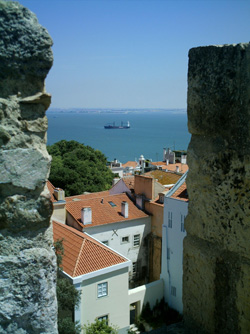
    View from Castelo de São Jorge
    © ILWL

    Walking round the gardens there seems to be a wonderful mix of stone and design reflecting the different ages of use and abuse. I should note however that much of what you see is a reconstruction of the more ancient buildings.

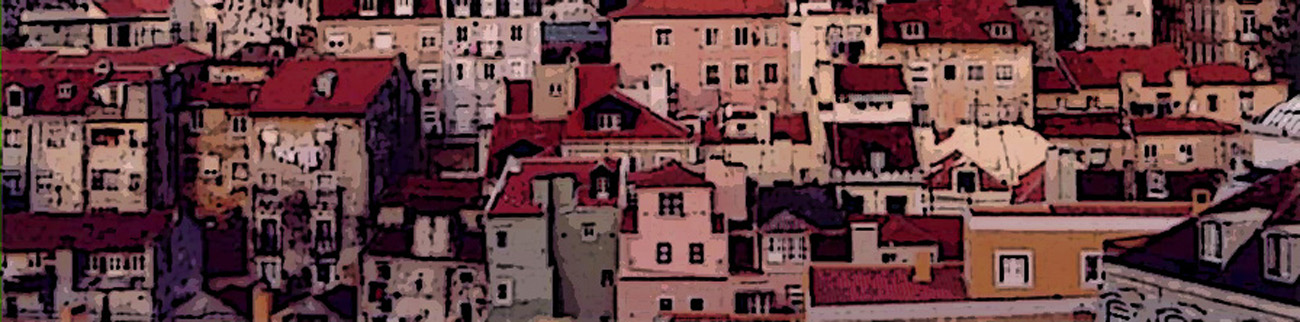
    If you are on your first visit to Lisbon, take a stroll down to Praça Figueira and gaze up at the castle whilst nursing a coffee at Cafe Suiça. Then, jump on the number 28 tram and journey up the hill. The castle offers you fantastic views of the city as a whole and you can get a feel for the beautiful city. You can see the red top roofs of the houses and the picture perfect postcard jumble of the Alfama. The Tejo glitters in the sunlight.

    The tram driver will always yell “castelo, castelo” when you arrive at the stop for the castle so you have no need to fear that you will miss where to get off. As soon as you leave the tram, take the tiny winding road up the hill to your left. As you trek up the cobbled streets, you will see a variety of gift shops selling a broad range of tourist paraphernalia. Whilst I would recommend saving your pennies and buying a map from the local bookshop in town, there are some nice little gifts to be found in these shops if you are looking to buy holiday presents for friends (or indeed yourself). I found the shopkeepers to be friendly and helpful. There are also a few cafes and bars and the occassional fado singer.

    The castle itself is surrounded by beautiful gardens and is a haven of peace. Take your time to wander across the battlements and gaze out across the Tejo. The information board on the outer wall of the main terrace (Praça D’Armas) shows you an outline of the skyline and marks all the important places and buildings. Canons point out across the city.
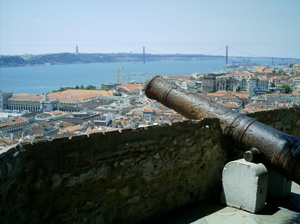
    Castelo de São Jorge Canon
    © ILWL

    On my visit I stayed outside in the gardens as there was so much to see and photograph. However there is also the periscope in the Tower of Ulysses that gives you a 360 degree view of the city. If you wish to rest your aching feet for a while, there is also a cafe.

    I adored the statues within the grounds and I have previously written about the poem I found there. Like any of the popular tourist attractions, the weekends are likely to be very busy. Weekday mornings are perhaps the best time. Note that it’s closed on Mondays.
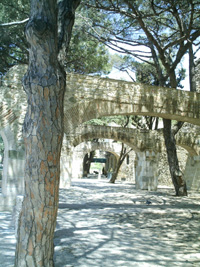
    Castelo de São Jorge - grounds
    © ILWL

    It costs €7.50 euros (circa 2012) to gain entry to the castle. Some people feel that the castle is not worth visiting due to the fact that much of it is reconstructed. However, I think it is worth the visit if only to experience the shady walks beneath the pine and cork trees and gaze out over the spectacular views. Whilst history may have been distorted, the castle is a feature of Lisbon present. Even if not all the walls are ancient, the land beneath is. I wonder how many warriers, how many kings, how many prison guards have gazed across this landscape too. I mark their footsteps with my feet and keep their memory in my heart.

    Castelo de São Jorge Official Site



  • The Gothic Ruins of Carmo Convent

    Azulejo 31I watched a lot of horror films when I was young and adored the extravagant Vincent Price. I devoured Edger Allen Poe and languished in Wuthering Heights. I can hold my hands up and admit I was a Goth in my teen years and still have a predisposition to wearing black, green and purple and a have love of ‘epic’ music.

    It was on my first trip to Lisbon when I spied the gothic ruins of the Carmo Convent (Convento do Carmo) for the first time. I was gazing out across Lisbon from the walls of Castelo de São Jorge and a Brazilian man began to point out the sites to me. Even from that far away, I could see the magnificent ruins etched a beautiful silhouette into the skyline. I spied it once again, looking up from Praça Rossio, the arches striking against the blue sky yet hiding the mysteries within its walls.

    So on my last trip over, I made a point of making a proper visit to Carmo. Situated in Baixa it is most easily reached by a trip up the Santa Justa Elevador which will bring you up to Largo do Carmo. Largo do Carmo is a pretty little square at the front of the Convent where elderly men gather around stone tables to play cards and people sip coffee in the sunshine. It is amazing to think that this quiet square was one of the focal points of the political revolution in 1974. People carrying carnations persuaded the soldiers upholding the dictatorship to stand aside by placing flowers in the barrels of their guns. Perhaps it is fitting that the grounds around this ancient church witnessed one of the most peaceful revolutions in history.

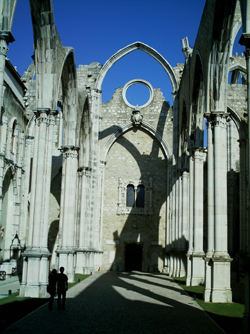
    Covento do Carmo
    © ILWL

    It costs €2.5 (circa 2007) to enter the ruins. There wasn’t a soul there as I walked down the steps and out into the roofless nave. The place was absolutely silent and the blazing sun cast stark shadows. I gazed up at the awe-inspiring arches that loomed above me and squinted at the glaring white stone. Whatever faith or lack of faith the vistor has, it is impossible not to experience an all pervading sense of peace. It’s easy to imagine nuns serenely in prayer and whispered incantations.

    I’m not a Christian, I’ve always been drawn to older religions and practices but Carmo felt like one of those places that has always been sacred; like the land itself was awake with divinity. I remember having this same experience at Glastonbury Abbey – of all the Pagan places I had visited, the Abbey strangely had the most effect upon me. It is said that our old churches were built on ancient places of power, ley lines and springs and temples to old Gods. It makes sense that humankind is drawn to worship in places that its ancestors also sanctified.

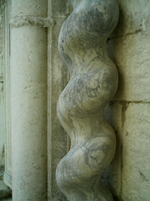
    So I wandered through the Nave that had become a garden, trailing my fingers across the stone and taking in the marvels of marble and sculpture. Gargoyles stared out from the places in the walls both guarding me and watching me. There were giant columns of stone, huge archways, figureheads and statues.

    Convento do Carmo detail
    © ILWL

    After a time I entered the main museum at the far end of the nave. Three giant lanterns hung beneath a vast domed ceiling and all around were tombs. I wondered if they were still occupied. Walking into the next room there was no such ambiguity. Shrunken heads and mummies made up part of the collection. The heads seemed impossibly small yet the hair was undeniably human.

    On into the next room and there was a maquet of how the church would have looked before the great earthquake that brought down its roof. Looking up in each room I spied intricate azulejos panels adorning the walls. Finally I reached the small museum shop which had the atmosphere of a library. I crept across the floor to the window to gaze out across the wonderful view of Lisbon.

    It’s funny, I could have sworn I’d already written this entry. As I wrote the first few lines I had a curious sense of deja-vu. I even checked my archives just to make sure before I posted this and even now I am not entirely convinved I haven’t already written this piece!

    Perhaps a little part of the convent has remained with me. The Carmo ruins are a stark reminder of the power of nature and the power of prayer as well as a curious place where time has stood still. One can step in and out of the past and the future in a heartbeat and find that when it comes to peace, it is the same in any era.

    Opening Times (updated 2015 from a comment by a website visitor – thank you!)

    May – September – 10am to 7pm
    Oct – Apr – 10am to 6pm
    During the summer, the museum is open from 10am to 10pm every Thursday.
    CLOSED ON SUNDAYS

    Prices:
    3,50€ normal ticket
    2,50€ students and over 65