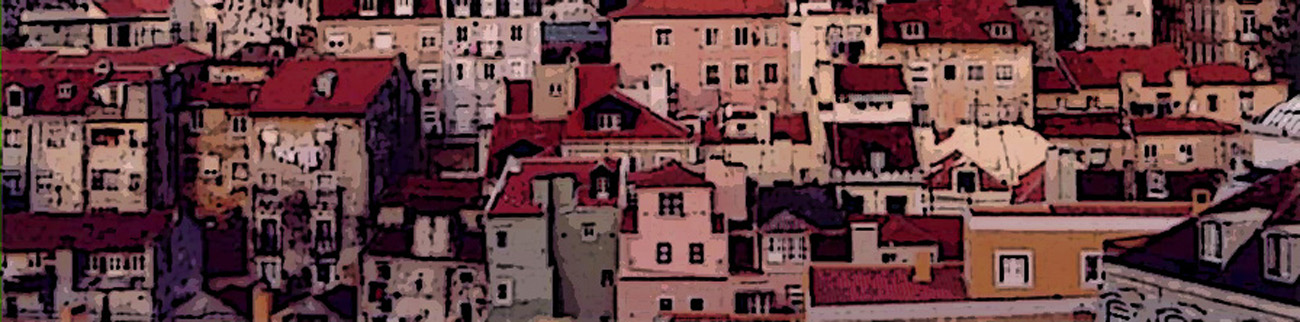

Some months ago I was delighted to receive a review copy of The Moon Come to Earth: Dispatches from Lisbon. Now, as an astrologer with a rather obvious passion for Portugal there perhaps could not be a more suitable book for me!
The summer disappeared in a haze of studying and an insane days filled with hours of over-time, squeezing in my Portuguese studies where I could. I have had little time to take in my own surrounding let alone travel. I miss Lisbon like a desperate child lost in a giant supermarket. I want to go home but I can’t! I feel like stamping my feet but I must wait, be sensible, and focus on developing a career that means I can work from anywhere to the march of my own drum. But Lisbon calls to me through the pictures on my walls, through the voice of a special Portuguese someone, through Madredeus and Fado, through the gorgeous David Fonseca and endless poetry. And more recently still my two selves have begun to merge in discovering Pessoa was a highly skilled astrologer himself…
But I digress. The Moon Come to Earth was born from a series of Dispatches from Lisbon which Philip Graham first published on the internet. A published writer and a university lecturer, Philip has a yearning for Portugal which I recognise as a kindred spirit. Having spent years living in Africa, he is a seasoned traveller with a keen eye for detail.

I can honestly say I was hooked from the first page. The author brings Lisbon and Portugal to life in his pages. I was suddenly roaming the mosaic streets with him, transported to my soul-home in a mere glance from the author’s eye. I was there on Rossio, walking in the leafy shade in Principe Real. I laughed at his hilarious descriptions of difficult moments and was touched by his openess as he lets us in to see the world through his sometimes fallible eyes. We learn what it is really like to be a stranger in a strange land that curiously feels like home.
I loved the description of his brave fight to learn Portuguese as his daughter effortlessly absorbs it as a youngster does: his love – hate relationship with the swallowing of vowels and the sea like oosh…oosh..of spoken European Portuguese.
“It’s actually this confounded swallowing that creates the wave of sound I love, the words melting their discrete borders into a collective enterprise that rises amd falls together, like the houses dotting the hills of Lisbon’.
Philip paints a vivid picture of Portugal and the Portuguese culture from one who truly respects it. He describes the quiet passion of the Portuguese people, their love of festivals and football and the huge pride in national writers. We are treated to lines from Pessoa and Saramago (with whom he recounts a slightly icy meeting) and gently guided through a history of the Portugal and its flourishing from Cape Verde to politics, through fado to the quiet revolution. Whilst the book is quite short, there is a wealth of material to start your own Portuguese odyssey.
I don’t want to give anything away but suffice is to say that towards the end of the book there is a denouement that I never saw coming and which savagely pulled at my heartstrings. Because woven within the pages, within the swallowed vowels and billions of calçada stones, in the lines between Saramago and Pessoa, hanging in the scent of galão and pasteis; there is a very human story. This is not just an embellished travel journey, this is a story of one family and their fierce and delicate love for each other. Philip is not shy to admit his struggles as well as his victories. He is a writer with a keenly perceptive eye for detail and he is not afraid to turn that eye upon himself, to see himself in black and white and every shade of grey as we humans are. I’m not afraid to say the book moved me to tears as well as laughter.
I’ve often felt that you cannot learn the word ‘saudade’ without eventually coming to live the true meaning of it. It’s as though it is not a word to be simply spoken, it must be lived through all it’s bewitching sorrow and aching hope. It’s as though the word has a spirit of its own that comes to greet you as you whisper ‘saudade’.
It whispers back “Dance with me a while and you shall know me”.
I know I danced and so it seems, did Philip Graham and his family.

