Author: Lily

  • The Tile Museum – Museu do Azulejo

    I have an endless fascination with the mosaic tile found at every turn in Lisbon and throughout Portugal. The beautiful intricate patterns adorning the streets and buildings are a precious commodity and a defining feature. From ordinary town houses to palaces and monuments, Portuguese tile is found everywhere.
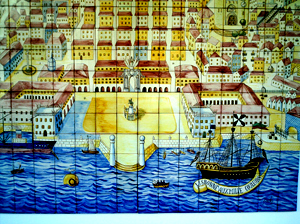
    Lisbon tile museum
    © ILWL

    The word Azulejo stems from the Moorish occupation during the 8th century. Azulejo is derived from the Arabic “al -zulecha” meaning “small Stone”. Traditionally the Koran bans images of living things so the patterns originally were made up of complex geometric designs. Over the centuries, as Moorish influence declined, this patterns changed and you could find not only geometric designs but also scenes of flora and fauna as well as humans. Religious imagery was favoured initially, closely followed by images afforded by the upper classes such as hunting and feasting. The voyages of Vasco de Gama also became popular. History and fantasy became glorious visual delights of sometimes huge proportions. Some of the larger pieces in churches were referred to as tapetasas because they were like a carpet/rug of tile.

    Like any traditional art form, the azulejos designs went through different fashions – from the Dutch influenced blue and white tile to Neoclassical to bright multicoloured to Art Deco. Whilst there are still some traditional artists, these days the majority of the tiles you’ll see on sale are mass produced.
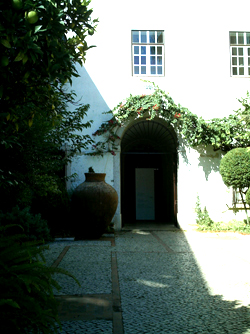
    Lisbon Tile Museum
    © ILWL

    If you also adore this wonderful art-form then take a trip to the Museu do Azulejo. Take bus number 794 from Praça Comércio which leaves from the right hand side of the square if you are facing the river. This will drive you along the river front to Rua Madre De Deus (yes this is where the band got their name from). You need to get off at the 9th stop which is right outside a big white church to your left. The Musuem is set within the Convent of Madre De Deus which is a beautiful and peaceful setting. Inside the museum are a wide variety of tiles from different ages including the longest azulejo piece in Portugal showing a panoramic view of Lisbon.

    Through the sculptures on the first floor, you reach an impressively adorned room with giant blue and white azulejos and paintings. Make sure you walk on the carpet. I was so busy looking at the tiles I missed the sign and received a reprimand from the museum assistant! There are examples of talha dourada here as well. Talha dourada is a specific technique of working with wood which you can often see in churches. It is highly ornate gold painted carved wood which was created by skilled artists.
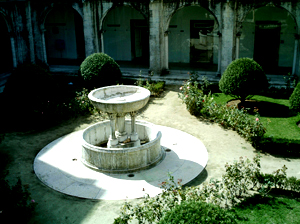
    Lisbon Tile Museum Gardens
    © ILWL

    I loved my couple of hours here. The building and the light were perfect for the tiles on show. Note that flash photography is not allowed.

    Do take a trip to the cafe and sit outside in the zen garden with a cup of coffee. I sat out there for quite some time just enjoying the silence and the plip of goldfish and turtles in the pond.

    The entry fee is €5 (circa 2012)
    Museu do Azulejo Official Site

    For a fantastic introduction to Azulejos check out The Art of Azulejo in Portugal

  • Alfama – Lisbon’s Oldest District

    Azulejo 1If you are visiting Lisbon then a walk around Alfama should definitely be on your must do list. Alfama is part of old Lisbon, the part that withstood the earthquake of 1755. The higgledy-piggeldy streets in this once no go area have in recent years opened up to the world and become a wonderful place to explore. Expect to get lost. It’s almost impossible to follow a map – let go and step back in time.

    The tiny cobbled streets are mostly too small for cars, indeed you sometimes might want to breathe in when travelling on the tram through here! Steep hills and maze like streets wiggle their way down to the Tejo – these are known as travessas or becos instead of ruas. There are many sites to see here such as the Sé Cathedral, the Church of Saint Anthony (where St. Anthony was born), the Museum of Decoratives Arts, Lisbon Castle, the Puppet Museum, the Church of São Vincente de Fora, the Military Museum and the Museum of Water.  A flea-market (Feira da Ladra) is held every Tuesday and Saturday morning and has much the same feeling as a Moroccan market – wonders hidden beneath trinkets and tat.

    Alfama Graffiti
    © ILWL

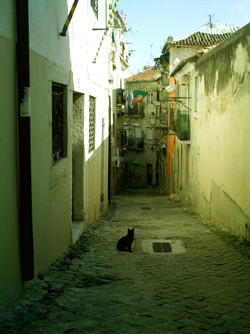
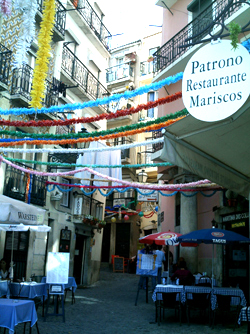
    Personally I feel that the main attraction is the streets themselves. Steps from the Miradouro das Portas do Sol take you down into the area. A funny piece of graffiti requests that you to respect the silence: Alfama is a peaceful place. Often streets are deserted aside from a stray cat  sitting in a patch of sunlight. On other streets, dogs bark or wag their tails from tiny balconies, children kick footballs, birds sing from cages dangling from windows and elderly ladies sit quietly in their doorways. On almost any street you are guaranteed to see the typical Lisbon site of washing hanging outside the windows and sometimes streamers from old festivals still decorate the streets.

    Alley cat - Alfama
    © ILWL

    Alfama is beautiful although I have to say the second time I visited there I was alone and felt a little more vulnerable. I did get very lost and had difficulty finding my way out. I spotted a rogue teenager who had a glint in his eye following me, so had to take different roads than the ones I thought I needed. In the end, fed up with the dance, I turned round and took his photograph – that seemed to put a stop to it!

    Generally though, I would suggest if you are lost, just decide to make for up or down – you will eventually hit the water or end up back near the castle.

    There are plenty of little bars, cafes and shops to sit in and enjoy the atmosphere. I particularly like the tiny fado bars on the edge of Alfama almost opposite the Fado museum. If you are keen on photography, Alfama offers some picture postcard scenes and plenty of atmospheric alleyways. Azulejos abound in the area and there are also parts that are extremely run down or derelict yet have fantastic graffiti. Under Arab occupation the area was known as al-hamma meaning spring or bath as hot springs are found here. However, as the Moorish rule fell, Alfama became an area where the poorer people lived. Fishermen often lived here with their families.

    Alfama streamers
    © ILWL

    These days Alfama is a wonderful mix of old and new so typical of Lisbon in general. The ancient traditions are still evident in the ladies taking their washing to the public washing baths and the smoky fado bars yet you can find funky hip clubs and trendy bars down near the docks. Wandering in Alfama is perfect inspiration for the photographer, musician, novelist and film-maker alike.

    Alfama is easy to find – just take the 28 tram to Miradouro das Portas do Sol (the stop after the castle). Alternatively you can get off at the castle and carry on walking up the hill past Miradouro de Santa Luzia. Look for the open air cafe  to your right for the fantastic view. The steps down are just there.

    There is an excellent collection of photos in the Alfama group on Flickr. Take a look here.